How many Senegalese companies export today under the AfCFTA preferential regime? Nobody publishes that figure. And its absence says more than any press release. Yet 2025 will be remembered as a record-breaking year: exports jumped 48.5% to 5,805.6 billion CFA francs, $10.4 billion (ANSD). Behind the performance, however, lies a paradox: this growth owes almost nothing to the great continental market the Agreement promised to open. Here is why and where the real opportunity lies.
Senegal, an economy built for the AfCFTA
Let us begin with what makes the Senegalese case singular. Senegal is one of West Africa’s most diversified economies: services account for around 56% of GDP, industry 25%, agriculture 19%, with an export basket that runs from hydrocarbons to gold, phosphoric acid to fishery products, cement to fertilisers, where so many neighbours depend on one or two products. The BCEAO regularly ranks it among the most diversified economies in the Union.
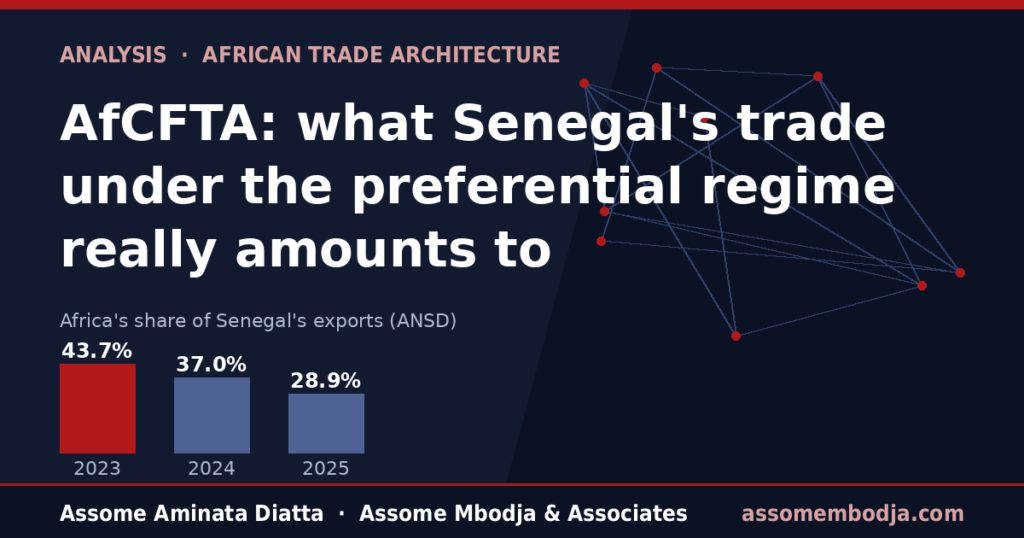
This diversity is matched by a rare continental orientation. Over the past decade, Senegal has made more than 40% of its exports to the African continent, still 43.7% in 2023 according to ANSD, nearly three times the African average, where intra-continental trade plateaus at around 14 to 15%. Few African countries sell as much to Africa.
It is no accident that Senegal was among the first signatories in Kigali in March 2018 and chaired the AfCFTA Council of Ministers of Trade of the States Parties during the decisive early implementation phase of 2019-2022, a chairmanship I had the honour of holding. In other words: a diversified economy, oriented towards Africa, which helped write the rules of the game. On paper, the ideal candidate for the preferential regime. But what do the facts say?
The 5,805.6 billion CFA francs of 2025 (against 3,909.1 billion in 2024) are explained first and foremost by hydrocarbons and precious metals: crude oil more than tripled (1,528.0 billion CFA francs, or $2.7 billion), gold at 978.0 billion ($1.8 billion), refined products at 860.6 billion, and the first LNG shipments. The result: a trade deficit cut by a factor of 2.4 (1,343.9 billion CFA francs, or $2.4 billion, against 3,252.3 billion). By the end of May 2026, exports and imports stood in unprecedented near-balance. Yet 83% of this gain comes from three raw commodities, while groundnuts and canned fish collapse: the country has traded import dependency for exposure to the terms of trade.
Geography follows the cargo. Europe now absorbs 41.8% of shipments, Africa 28.9%, Asia 18.2%. Sales to the continent are nonetheless growing, 1,680.0 billion CFA francs ($3.0 billion), up 16.2%. However, 86.4% go to ECOWAS and AES countries, with Mali alone concentrating 55.4%. And these flows move under the ECOWAS Trade Liberalisation Scheme, whose preferences take legal precedence over the AfCFTA. One could therefore say that the overwhelming majority of Senegal’s African trade owes nothing to the continental preferential regime.
What the figures do not say
The AfCFTA machine is moving. 48 schedules of tariff concessions have been adopted, and 8,449 certificates of origin issued by ten States Parties. While Egypt has accumulated more than 2,852 certificates, Tanzania more than 392 and Tunisia more than 300, Senegal has yet to record significant flows under the preferential regime. No public statistics document the certificates issued on the Senegalese side. Yet Africa absorbs 28.9% of our exports while supplying only 12% of our imports. It is the only space where Senegal runs a structural surplus and the only one where it sells processed goods: three quarters of our refined products (659.8 billion CFA francs, $1.2 billion), cement, fertilisers. Europe buys our crude; Africa buys Senegalese work. And the growing concentration on hydrocarbons and gold is mechanically eroding that diversification. The ten families of AfCFTA-potential products identified by the DGPPE, seafood, fruit, food preparations, are precisely the ones that would preserve it.
What this changes for SMEs, investors, institutions
For an exporting SME, the rational strategy is not to “export under the AfCFTA” in general, but to target a market outside ECOWAS where the tariff differential justifies the cost of compliance: a product from the ten DGPPE families, the rate verified on the e-Tariff Book, the rule of origin mastered, after first confirming that the destination country’s schedule of concessions has been published and its customs system actually configured, which almost everyone forgets. Capacity, for its part, is beyond doubt: Patisen already sells in some thirty African countries and earns two thirds of its revenue from exports. What is missing is not the know-how; it is the legal regime for the next step.
For an international investor, Senegal is a dual-trigger platform offering immediate access to ECOWAS and an AfCFTA option on the rest of the continent.
For institutions and donors, the indicator to fund is the gap between mapped potential and actual flows under the preferential regime: origin certification, digitalisation of one-stop shops, corridors beyond ECOWAS.
Turning potential into reality
In 2025, Senegal confirmed its export power; the AfCFTA, for its part, still awaits its Senegalese moment. The market exists. The regulatory framework has been built. Senegal, a country that contributed so much to writing the rules of the great African market, cannot remain a spectator of their application. The question is no longer “does the AfCFTA work?” It is: “who, in Dakar, will seize it first?”
I explore all of these questions, the ECOWAS tariff offer, the mechanics of certificates, the calendar for the next twelve months and an operational checklist for exporters, in the first issue of Le Point Stratégique, published on 27 August.
Note: US dollar equivalents at the 2025 average rate of approximately 556 CFA francs per USD.