
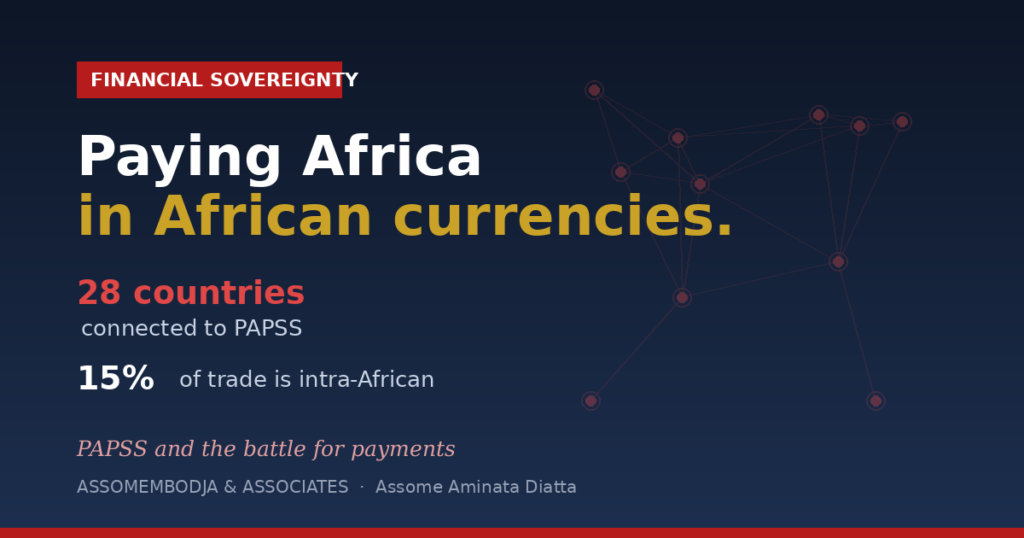
It is one of the great paradoxes of African trade: Africa pays Africa in dollars!
The continent counts more than 40 currencies, yet it is a foreign one that settles most of its trade. Before the launch of PAPSS, over 80% of cross-border payments originated by African banks were cleared and settled outside the continent, through correspondent banks.
In zones that share a common currency, WAEMU in West Africa and CEMAC in Central Africa, trade between member countries is settled in the same currency, with no exchange fees. But as soon as a transaction crosses the border between the two zones, the dollar or the euro steps in. Two African companies, two neighbouring countries, sometimes two subsidiaries of the same group, must go through a bank in London, Paris or New York to pay each other.
This detour comes at a cost: in foreign currency, in delays, in sovereignty. More than 5 billion dollars a year go up in transaction and conversion fees, according to Afreximbank estimates. Up to seven days of waiting to receive a payment, even between entities of the same group. And no control over African financial data, which travels through foreign infrastructure.
This is the paradox the Pan-African Payment and Settlement System (PAPSS) intends to eliminate.
What Is PAPSS?
PAPSS is a financial market infrastructure designed to enable cross-border payments between African countries, in local currencies, without going through correspondent banks outside Africa. Championed by Afreximbank, in collaboration with the African Union and the AfCFTA Secretariat, PAPSS was commercially launched in January 2022 in Accra, following a successful pilot in the West African Monetary Zone.
The principle is simple. But it is powerful. Instead of routing every transaction through the dollar, PAPSS settles payments in local currencies and performs multilateral netting: only the net balance between countries is actually exchanged. An importer pays in their own currency, the exporter receives in theirs, and settlement takes place within the continent, instantly or nearly so.
The gains are real: up to 27% lower costs for the end user, according to figures put forward by the system, and settlement times cut from several days to a few seconds on operational corridors. The data stays in Africa. That last point is not merely symbolic: it is a matter of sovereignty, at a time when control over payment data has become a strategic asset.
PAPSS Is Gaining Momentum Fast
The progress is notable. Starting from the West African pilot, PAPSS has expanded to four regions of the continent. By early 2026, it connected 19 active countries, some fifteen signatory central banks and around 160 commercial banks, alongside fintechs and some fifteen national payment switches.
But the most significant acceleration is very recent. On 9 July 2026, the Bank of Central African States (BEAC) formalised its accession, signed in Yaoundé, opening the system to the CEMAC zone (Cameroon, Central African Republic, Congo, Gabon, Equatorial Guinea, Chad), home to more than 72 million people. With this entry, the network claims 28 countries, 16 payment switches and more than 190 banks and fintechs. One point of honesty is in order, however: the central bank’s accession does not, at a stroke, connect every bank in the sub-region. The effective integration of CEMAC financial institutions is expected by the end of 2026.
The year 2025 had already marked a turning point. In June came the launch of PAPSSCARD, the first pan-African payment card, unveiled at Afreximbank’s 32nd Annual Meetings in Abuja, in partnership with Mercury Payment Services. Its ambition: to compete with foreign card networks by processing transactions entirely on the continent, keeping the fees, the data and the value in Africa. In July came the launch of the PAPSS African Currency Marketplace (PACM), developed with African deep-tech company Interstellar: a platform for direct exchange between African currencies, tackling the problem of inconvertibility head-on, without going through an external hard currency.
The message is clear: PAPSS no longer wants to be merely a payment rail, but the foundation of an integrated African financial system.
What About West Africa? The BCEAO Building Block
For a West African reader, the question is immediate: where does our region stand?
Banks in the West African Monetary Zone are already PAPSS members. The challenge now is to generalise the connection of banks in the eight member states not yet covered, to ensure PAPSS–EPSS interoperability, and to bring in payment and electronic money institutions, the main drivers of financial inclusion in the region. This payment infrastructure also underpins the credibility of the Eco roadmap.
For WAEMU, the answer lies at two levels which will soon become one.
At the sub-regional level, the BCEAO launched its own infrastructure on 30 September 2025: the Interoperable Platform of the Instant Payment System (PI-SPI), covering the eight WAEMU countries, including Senegal. It enables instant, interoperable and secure payments, around the clock. As of 24 June 2026, 80 participants were connected: banks, electronic money institutions, microfinance institutions and payment institutions. A further 74 institutions were also in live testing ahead of opening their services to the public.
The Central Bank has made connection mandatory. Initially set for 30 June 2026, the deadline was pushed back, in a communiqué dated 25 June 2026, to 30 September 2026 for banks, electronic money institutions and payment institutions, and to 30 June 2027 for microfinance institutions. This extension is worth noting: it signals, without saying so, that real-world adoption is moving more slowly than the initial timetable had hoped.
The decisive point lies elsewhere. The regional PI-SPI and the continental PAPSS are set to interconnect. A pilot phase with the BCEAO, announced for the course of 2026 in the official communiqué published by PAPSS upon BEAC’s accession, is taking shape. Indeed, according to a Central Bank official speaking to the press on 21 July 2026 in Dakar, it will last six months and mobilise more than 80 WAEMU commercial banks for cross-border payments. One institutional detail speaks volumes: where BEAC signed a full accession, the BCEAO is participating, for now, as an observer, a caution that reminds us the continent’s central banks are not all moving at the same pace.
Coupled with BEAC’s accession, this pilot could connect most of francophone Africa to the pan-African network. A two-tier architecture is taking shape: one regional building block per monetary bloc, linked to a shared continental rail. For a Senegalese company, this means, in time, paying a Cameroonian supplier as easily as a local one.
What the Press Releases Don’t Say
I will be frank, because that is where the value of analysis, rather than the relaying of announcements, lies. The network’s growth is real, but everyday usage still falls short of the promise.
On the ground, frictions persist. Users, including on major corridors such as Nigeria and Ghana, continue to report delays, transaction limits, heavier documentation requirements and, above all, low awareness of the system. Some professionals still open an account in a neighbouring country in order to get paid, unaware that PAPSS exists or works for their case. The extension to mobile wallets, decisive in Africa, where mobile money dominates, is only just beginning: the partnership concluded in February 2026 with Pesalink in Kenya, connecting more than 80 Kenyan banks, fintechs and operators to the network, is a first concrete bridge, but it remains the exception rather than the rule.
Two structural obstacles remain. The first is adoption: many SMEs are unaware of the system, banks must modernise their infrastructure and train their teams, and some monetary authorities themselves long held back, unsure of what PAPSS was there to do. Afreximbank now acknowledges this publicly. The postponement of the BCEAO’s deadlines is the most concrete sign of it. The second is interoperability: every country has its own payment system, its own regulatory framework, its own standards, and aligning them requires considerable technical and financial investment. Some thirty African countries remain outside the network; CEMAC’s entry reduces that number, but the road is long.
PAPSS has solved the technical question. It still has to win the battle of usage.
Why This Matters for Investors and Businesses
For an investor or a company operating in Africa, PAPSS is not some distant matter of monetary policy. It is a concrete factor of cost and cash flow.
A group with a presence in several African countries can, thanks to PAPSS, transfer funds between its subsidiaries in local currencies, without incurring the fees and delays of the correspondent banking system. A company exporting to a neighbouring African market can get paid faster and at lower cost. And as the network expands, the competitive advantage shifts towards those who learn to use it early.
But there is a broader issue at stake. PAPSS is part of the same movement as the New African Financial Architecture for Development (NAFAD) (which I discussed with you last week) and the African Continental Free Trade Area (AfCFTA). It is about an Africa that builds its own financial infrastructure, reduces its dependence on foreign currencies and networks, and seeks to retain value on the continent. For international capital, this is not a closing-off; it is an invitation to operate in an environment that is becoming more structured, more rational and easier to read.
PAPSS Is One More Step Towards Sovereignty
PAPSS, like NAFAD, goes beyond financial engineering alone. Paying in dollars for a trade between two African countries means accepting that the value, the fees and the data travel, and sometimes remain, outside the continent. Taking back control of the payment rails means taking back control of a share of one’s economic sovereignty.
The infrastructure now exists. The technology works. What will determine its success is no longer a question of engineering, but of adoption: the willingness of banks to integrate it, of regulators to harmonise it, and of businesses to use it. As so often with African integration, the tool precedes the usage. The gap remains to be closed.
The question is no longer “can Africa be paid in African currencies?”. The question now is “who will seize it first?”.
Assome Aminata Diatta