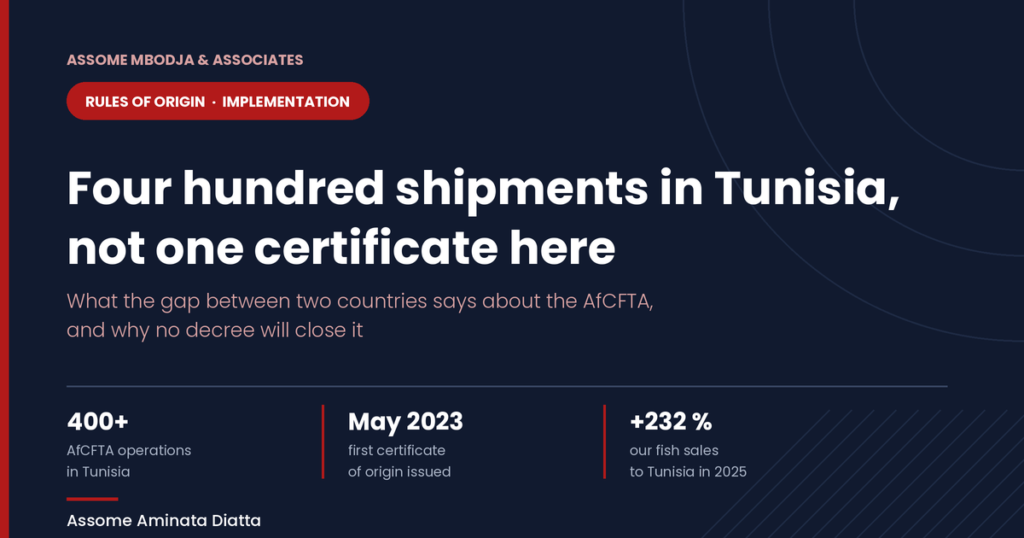
What the gap between two countries says about the AfCFTA, and why no decree will close it
By Assome Aminata Diatta | 22 October 2026
On 7 October, Tunisia’s Minister of Trade gave a figure. Since the first certificate of origin was issued in May 2023, more than four hundred export and import operations have been carried out in Tunisia under the AfCFTA regime.
And he added a sentence worth reading twice: for the private sector, the question is no longer whether the mechanism exists.
Let us start by saying that four hundred is not much
I am not going to turn that figure into a success story. Four hundred operations in three and a half years, for an economy the size of Tunisia’s, is modest. Measured against Tunisian foreign trade as a whole, it barely registers.
But it is four hundred more than we have.
When I was writing the first issue of this publication, in August, Senegal had designated its competent authority for issuing AfCFTA certificates of origin, and not one certificate had yet been issued. Not a single one. So the gap with Tunisia is not a gap in performance. It is a gap in kind: on one side a procedure that works, however slowly, on the other a procedure that has never once been run.
What the gap is not
It would be convenient to explain this by a lack of political will. That would be false, and above all it would be useless.
Senegal signed, ratified and designated. It took part in the negotiation, and it chaired the AfCFTA Council of Ministers responsible for trade. Commitment is not the issue.
The gap lies elsewhere, and it is far more ordinary. For a certificate to exist, a company has to know it may apply for one, it has to know whom to ask, an officer has to know how to receive the file, how to examine an origin criterion, and then sign. Five actions. None of them political. All of them operational, and it takes only one of them to be missing for the entire chain to stand still.
That is exactly what the Tunisian minister is saying when he states that the question is no longer whether the mechanism exists. A mechanism that exists on paper and a mechanism that issues documents are two different things, and the distance between them is not crossed by passing another text.
What the gap costs us, in one sentence
Here is the detail that should stop us.
Our fresh fish sales to Tunisia grew by 232 % in 2025, at full tariff. So we are selling, in rising volumes, to the very country that has learned to use the agreement, and we are paying the customs duty it no longer pays.
The demand is there. The market is growing without any help. The only missing element is a document we are not yet issuing.
This is the point I have been making for three issues, and this example makes it hard to argue with: what we lack is not the market, it is the procedure.
What a company can do without waiting
I always end here, because an analysis that does not point to the next move is of no use to anyone.
Below 5,000 dollars, you need no one. The Agreement allows the exporter to declare origin on the invoice itself, without going through any administration. That option is open today, and it covers a great many trial shipments.
Above that threshold, apply formally, and in writing. A written request that goes unanswered is information in itself, and it is also what eventually makes a procedure move. Mechanisms that never run are often the ones nobody has ever asked to use.
First check whether your product needs it at all. If you sell within WAEMU, your goods already move duty free and the AfCFTA adds nothing for you. The certificate matters only for markets beyond that, and Tunisia is one of them.These three steps, and the full procedure behind them, will be set out in the free webinar on Thursday 5 November, from 3 to 4 pm Dakar time