
My bank card costs me 200,000 FCFA a year, about 350 dollars. And that is only the entry ticket: every transaction then triggers its own commission. 70,685 FCFA over a single year statement, roughly 125 dollars, at about 1,755 FCFA (3 dollars) per international payment. That is the real price. Now multiply by millions of cardholders, month after month, and ask yourself where that money goes.
The question concerns far more people than it used to. For a long time, the bank card was a privilege reserved for account holders, in a region where strict banking penetration hovers around 20 percent: of the slightly more than 8 million cards issued in the WAEMU zone by the end of 2023, 6,338,017 were still tied to a bank account (BCEAO). Wave and Orange Money are democratising it: today, any mobile money account holder can carry a virtual card, topped up directly from their wallet. It is a quiet revolution, and it meets and serves another one: African e-commerce is exploding. According to Statista’s Digital Market Outlook projections, the share of Africans shopping online may have risen from about 13 percent in 2017 to nearly 40 percent by the end of 2025, in a market growing at 11.7 percent a year that could double its 2023 revenues (16.1 billion dollars) by 2028. So let us ask the real question: what does Africa gain from this boom, or rather: what does it lose?
The platforms we buy on do not belong to us. The payment rails we ride do not belong to us. That is no small detail: if payment systems are classified as infrastructure services, it is because they are to development what roads and electricity are to an economy. Whoever owns them collects a toll on everything that moves.
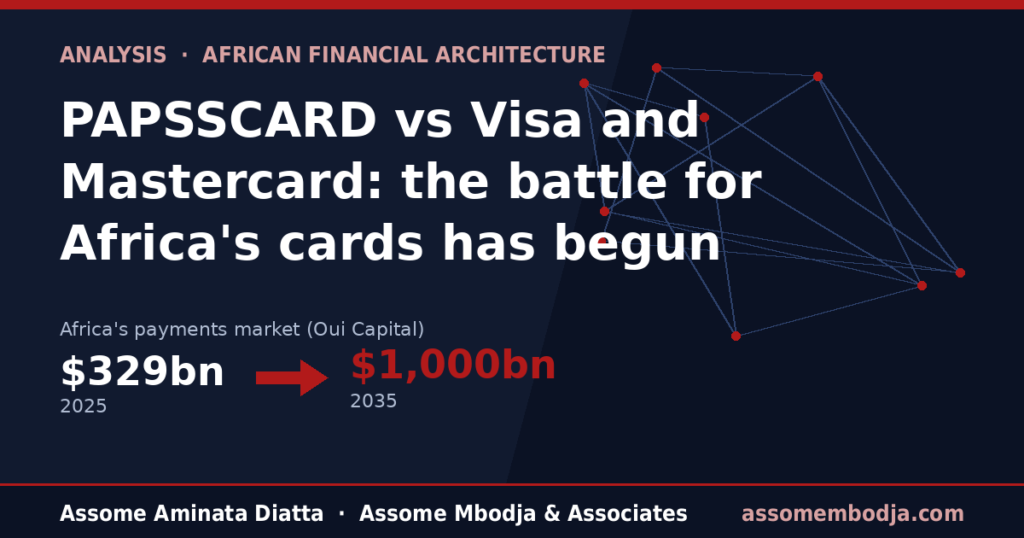
For most of the continent, the toll goes to two names: Visa and Mastercard. Two American networks that dominate issuance, set the rules of the game, take a share of the fees on every transaction and watch the payment data of hundreds of millions of Africans flow through their systems. My 1,755 FCFA are part of it. An African payments market estimated at 329 billion dollars in 2025, and expected to reach 1,000 billion by 2035 (Oui Capital). That is the rent now being contested by two offensives, one continental and one regional. And the second is playing out right now, in our WAEMU zone.
A market dominated from the outside
According to the Central Bank of West African States (BCEAO), in its regional payment-card dashboard for WAEMU at the end of 2023, 8,004,173 cards were in issue across the Union. Visa accounts for more than half of them (4,555,767 cards), including a significant share co-badged with GIM-UEMOA (1,773,845), while Mastercard accounted for 300,318. Add China’s UnionPay, present in more than forty African countries, and national schemes such as Verve from Nigeria’s Interswitch, with some twenty million cardholders across Nigeria, Ghana, Egypt and Angola.
The problem is not the presence of these networks, it is the architecture. When a transaction between a Senegalese cardholder and a Senegalese merchant is routed through an international network, part of the fees leaves the regional circuit, and the payment data transits through infrastructure outside the continent. Multiply by hundreds of millions of transactions and you get a quiet but structural haemorrhage, the card-payment twin of the dollar detour I analysed two weeks ago in relation to PAPSS.
PAPSSCARD: the continental answer
That is the circuit PAPSSCARD intends to cut out. Unveiled on 27 June 2025 at Afreximbank’s 32nd Annual Meetings in Abuja, the first pan-African card is a joint venture between Afreximbank, PAPSS and Mercury Payment Services. Its promise? To process transactions entirely on the continent, keeping the fees, the data and the value in Africa. Afreximbank’s president, Benedict Oramah, summed up the stakes at the launch: the historical dependence on external payment systems has hindered trade, inflated costs and compromised control over Africa’s financial data.
Deployment began with a telling pilot corridor: Bank of Kigali and I&M Bank Rwanda on the issuing side, national operator RSwitch in Rwanda, Unified Payments in Nigeria. A Kigali-Abuja axis that embodies intra-African business travel without a detour through a foreign network. The rollout is explicitly entrusted to central banks and national payment systems. And the card does not come alone: it completes the PAPSS edifice, with its instant payment system (IPS) and its African currency marketplace (PACM), of which it is the consumer-facing layer.
What the AfCFTA changes in the battle for cards
On 15 February 2025, the Conference of Heads of State of the African Union adopted the AfCFTA Protocol on Digital Trade and its annexes, which cover precisely cross-border digital payments, fintech, digital identities and data transfers. Following the continental e-commerce strategy of June 2024, Africa’s digital single market now has its legal framework, and the Secretariat is preparing the four-year plan for its implementation (FERDI, policy brief no. 281, March 2025).
But a protocol does not process payments. Intra-African trade is stuck at 15 percent of the continent’s total trade, against more than 60 percent in Europe. African e-commerce, expected to reach 40.8 billion dollars in 2025 and 60 billion by 2027, remains concentrated: South Africa, Nigeria and Kenya alone account for half of the continent’s online shoppers. And Africa weighs just 1 percent of global exports of digital services. Between the legal text and actual flows, one link is missing: continental payment rails. A Dakar SME selling online to Nairobi or Accra collects its money today through a foreign rail.
This is where everything comes together: PAPSSCARD and PAPSS are the execution layer of the AfCFTA digital protocol, its cross-border payments annex made tangible. The fintech passport inaugurated between Rwanda and Ghana, the first of its kind and aligned with the protocol, is its regulatory layer. Without these building blocks, the digital single market will remain an elegant text. With them, the question of transaction routing stops being a technical dispute among bankers: it becomes the first battle in the application of the digital AfCFTA.
Meanwhile, in WAEMU: the standoff has begun
If PAPSSCARD is the long-term answer, the immediate battle is being fought at home, and it is regulatory. Since 31 March 2026, Decision 31, proposed by GIM-UEMOA, validated by the BCEAO and adopted by the Union’s Council of Ministers, has required international operators (Visa, Mastercard, UnionPay) to route transactions made within the zone with cards issued in the zone through the regional GIM-Switch platform. An obligation that in fact dates back to 2015: ten years of successive postponements, and the two American giants are still asking for more time, until October 2026.
The dispute has stopped being theoretical: in early 2026, several airlines operating in WAEMU suspended online payments with locally issued cards, caught between the regional obligation and the international networks. Since February, GIM-UEMOA’s managing director, Minayegnan Coulibaly, has been touring the region to rally bankers and merchants to the cause. What is at stake behind the technicalities of routing is exactly what I described above: who clears, who collects the domestic fees, and where the data lives. WAEMU’s monetary-payments sovereignty is being negotiated right now, transaction by transaction.
What the press releases do not say
Cards are a minority product in West Africa. With strict banking penetration at around 20 percent in WAEMU, the mass rail is not the card: it is mobile money, as Wave and Orange Money demonstrate daily in Senegal. The real battle for everyday payments sovereignty is being fought over mobile interoperability, that of the BCEAO’s PI-SPI. The card matters where it is irreplaceable: intra-African travel, e-commerce, government payments, corporates. It is a strategic front, not the main front.
But a card is only worth its acceptance network. Visa and Mastercard took half a century to weave theirs. PAPSSCARD starts on a Rwanda-Nigeria corridor; it will need years, and above all an architectural decision: to federate the existing national and regional switches, GIM-UEMOA first among them, rather than layering itself on top. India showed the way with RuPay, which became dominant through public procurement and its anchoring to a national instant payment system. PAPSSCARD will win if African states adopt it for their own payments and if it interconnects with what exists; it will fail if it becomes one more scheme in an already fragmented landscape.
Finally, ten years of postponements teach lucidity. The local routing obligation had been waiting since 2015; it was pushed back year after year, and the duopoly is still negotiating. Payments sovereignty is not decreed: it is wrested, through the combination of a regulatory constraint held firm over time and credible local alternatives. That is precisely the conjunction taking shape. Decision 31 on one side, PAPSSCARD and PI-SPI on the other. The 2026-2027 window is therefore decisive.
What it changes: banks, merchants, investors
For the zone’s banks, the issuing equation is reopening: between the requirements of Decision 31, the announced arrival of PAPSSCARD and the pressure from international schemes, every card division will have to arbitrate its co-badging portfolio within eighteen months. Those that anticipate the GIM-PAPSS interconnection will gain a head start.
For merchants and e-commerce, the current standoff is first and foremost an operational risk: the online payment suspensions proved it. Diversifying collection rails (local cards, mobile money, PI-SPI instant transfers) is no longer a comfort option, it is business-continuity insurance.
For investors, the reshuffle opens a rare space: merchant acquiring, card-to-mobile gateways and regional routing compliance services are the segments where value will shift. A market that triples by 2035 will not reward the same players as yesterday.
The card as a marker of a deeper shift
PAPSSCARD will not dethrone Visa and Mastercard in a year. No serious observer claims it will. But its very existence, combined with the regulatory firmness of GIM-UEMOA and the BCEAO, changes the nature of the negotiation: for the first time, the continent is talking to the duopoly with an alternative on the table. That is exactly how power balances shift.
The question is no longer whether Africa can have its own card. It is: which WAEMU bank will issue the first PAPSSCARD, and who will get it accepted by our merchants? As for my 70,685 FCFA in yearly fees, I now know exactly what they are: not charges, but a vote, one I would rather see fund African infrastructure in the future.
I will return to the outcome of the WAEMU standoff and to the PAPSS rollout in the full review Le Point Strategique will devote to payments in November. Before that, the first edition, on what Senegal’s trade under the AfCFTA preferential regime really amounts to, is out on 27 August.