What it costs an African company to sell outside its own currency zone, and what the pan-African payment system actually changes
By Assome Aminata Diatta | 15 October 2026
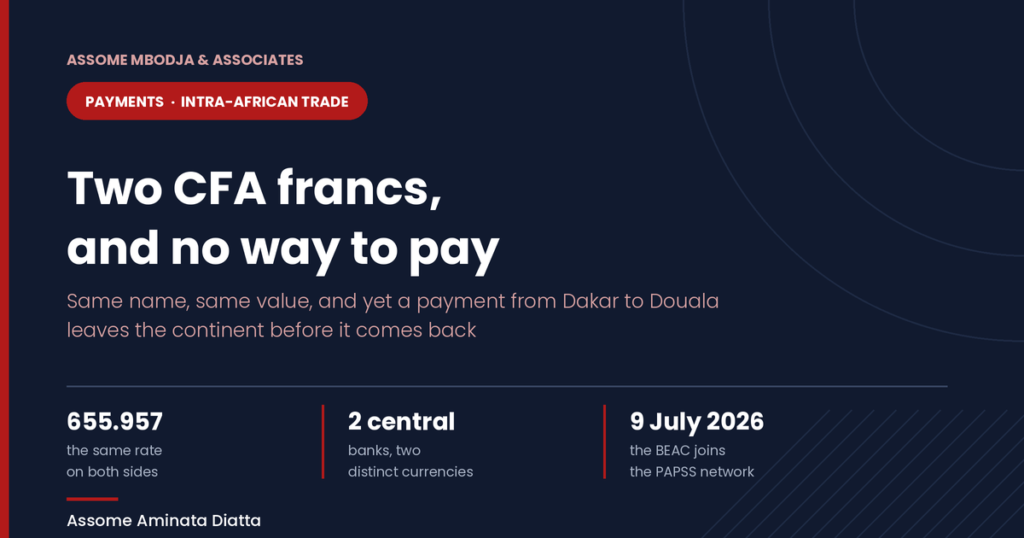
A company in Dakar sells a service to a client in Douala. Both countries use a currency called the CFA franc. Both are pegged to the euro at the same rate, 655.957 to one. Common sense says the payment should be a formality.
It is not.
The West African CFA franc and the Central African CFA franc are not the same currency. They are issued by two different central banks, neither is legal tender in the other’s territory, and the two are not interchangeable. You cannot settle an invoice denominated in Central African CFA francs using West African CFA francs. Same name, same value, and no direct way to pay each other.
So the payment leaves the continent. It goes through a conversion, through correspondent banks domiciled elsewhere, through fees and through delays. A Senegalese company selling in Douala is not making a CFA franc transaction. It is making a foreign exchange transaction.
If you trade from Lagos, Accra, Nairobi or Cairo, do not read this as a franc zone curiosity. The franc zone is simply the sharpest illustration of a continental fact: most payments between two African countries are still routed through a third currency, and through banks on another continent. The currency names differ. The cost structure does not.
The map is the same as it is for goods
None of this should surprise a regular reader of our work, because it is the third storey of the same wall.
The first issue of Le Point Stratégique showed that six of Senegal’s nine leading export products gain nothing from the AfCFTA, because they go to the West African Economic and Monetary Union, where they already move duty free. The second showed that services trade within ECOWAS sits at 2.4 per cent, the lowest figure on the continent after Central Africa. Payments say the same thing in their own language.
Inside a single currency area, everything works. One currency, one central bank, direct settlement. Beyond it, selling to Cameroon, Nigeria, Morocco or Kenya means every layer becomes difficult at the same time: the tariff, the recognition of origin, the opening of the services market, and now the payment. These are not four problems. They are one, and it begins exactly where the monetary area ends.
That is also where the demand is. Senegal’s fresh fish exports grew by 232 per cent to Tunisia and by 59 per cent to Morocco in 2025, at full tariff. The markets that are growing are the ones our payment systems serve worst.
What changed in 2026
The Pan-African Payment and Settlement System, known as PAPSS, was built for exactly this: to let two African companies settle in their own local currencies without passing through the dollar or the euro. It was slow to start. It is no longer.
More than thirty African countries are now covered, across all five regions of the continent, around ten of which joined during 2026 alone.
Twenty-four national and regional central banks participate, along with more than two hundred commercial banks and payment service providers.
Transaction volume is up roughly 1,000 per cent year on year, and value up roughly 120 per cent.
Cost per transaction falls by 92 to 95 per cent and foreign exchange requirements by up to 80 per cent, on the figures Afreximbank published in September 2026.
The second problem, which gets even less attention. The cost of conversion is not the worst of it. The worst is money that never comes back. Ethiopian Airlines, which sells tickets in dozens of African countries, had close to 500 million dollars trapped in countries that restrict access to foreign exchange. By December 2025 it had recovered around 360 million, about 72 per cent, with 140 million still blocked. If a carrier of that size takes years to repatriate its revenue, consider what happens to a small company that has invoiced and delivered. Ethiopia joined PAPSS in September 2026, and that is no coincidence.
For the franc zone, the date that matters is 9 July 2026. That day, the Bank of Central African States joined PAPSS, and banks across the CEMAC region are to be connected by the end of this year. The problem I have just described between Dakar and Douala is being addressed for the first time since the two francs came into existence.
What not to conclude from it
I enter the same caution here as I did for the certificate of origin, because it is the same mistake waiting to happen.
A central bank joining does not mean your bank is connected. Between a monetary authority’s decision and the moment your relationship manager can execute a transfer through that channel, there is technical work, there are agreements, and there is a commercial rollout. The first issue of this publication made the point on different ground: Senegal’s competent authority for AfCFTA certificates of origin exists, and not a single certificate had yet been issued. A mechanism existing is not the same as a mechanism being available to you.
The only way to find out where you stand is to ask your bank, by name.
Three questions to put to your banker
Is my bank connected to PAPSS, and since when? Ask for the answer in writing. A bank whose central bank has joined is not necessarily connected itself.
Which countries can I send to and receive from through that channel today? The list of live corridors is not the list of member countries. What matters is the corridor, not the flag.
What is the full cost compared with the usual route? Issuing fees, correspondent bank fees, the exchange margin applied and the time to availability. Have both routes priced on a real transaction, not on a principle.
If your contact cannot answer, that is not a bad sign about you. It is information about your bank, and it is worth comparing with another.
What a company can do about it now
You do not have to wait for all of this to be in place to get something out of it. Three moves are available today.
Stop treating the cost of payment as a fact of life. Put a number on it. On a sale outside your currency area, add up the bank charges, the exchange margin and the cost of the delay. You will then know what you are losing, and you can negotiate it.
Turn it into a commercial argument. If you can offer a Cameroonian or Nigerian client a cheaper and faster settlement than your competitors, that is worth a price concession, and it costs you nothing.
Settle the payment terms before you sign, not after. The settlement route is negotiated at contract stage. Once the work is delivered, you live with your client’s banking arrangements.
Issue 3 of Le Point Stratégique, published on Thursday 29 October 2026, will take this subject in full: what the pan-African payment system really changes for a small business, what it does not change, why an invoice in dollars is still often the rule between two African countries, and how to guard against the most underestimated risk of all, being paid in a currency you cannot take out of the country.
Sources: Afreximbank, press release of 11 September 2026 on the expansion of PAPSS; Agence Ecofin, 10 July 2026, on the accession of the BEAC; Addis Fortune, 29 September 2026, on Ethiopia’s accession and Ethiopian Airlines’ blocked revenue; the issuing regimes of the West African and Central African CFA francs; Agence nationale de la statistique et de la démographie, foreign trade 2025.